
Envisioning Executive Authority
an aesthetic of what needs to transpire

This essay was first published in the February issue of Appeals Magazine. Please considering purchasing a copy here. Also, this is not a prediction of what I believe will happen tonight. Just an envisioning of what could happen in the future.
It is, in my opinion, easy to pick out the four most aesthetically powerful Presidents.
Leading the way is Washington, his Crossing of the Delaware coming to mind first. This is an image that is of course pre-conception of the American presidency. One is inspired by the great general’s courage as he leads his men through the travails of a nation being born.
Second is Andrew Jackson. Initial images that come to mind also took place pre-presidency as well as during his own generalship. Sword in hand, battle raging on, Jackson displays the stubborn will that would follow him into the Oval Office. If Washington led us toward a new American Spirit, Jackson embodied it, securing a will and resolve set apart from the rest.
Theodore Roosevelt carries with him a wide variety of pleasing aesthetics. Perhaps the one that stands out most comes post-presidency while seeking another term, though an actual image of him remaining on stage and finishing his speech after being shot does not exist. It doesn’t have to. We can easily envision what that looked like–a man truly in the Arena.
Similar to TR in that it occurred post-first term as well as entailing being shot at, Trump, with blood splattered on his face, fighting off SS agents to pump his fist and admonish the crowd to do as he did, to “Fight, fight, fight!” should be an immortal image implanted within the minds of all Americans. Unlike TR, Trump achieved his second term.
The Left would have a different answer to the question of appealing presidential aesthetics. Instead of contemplating who they’d choose, because the mere image of Obama, feet on desk, in a tan suit repulses me, I will instead grant them this: FDR’s portrait was a mainstay in common households during the Great Depression, an uncommon practice up until that point, and something that hasn’t been repeated since… unless Trump/MAGA has reached that point?
While the men listed before FDR all lived a variety of active lives, with images both real and imagined depicting them standing, leading, enduring, and coaxing, FDR’s portrait displays a man sitting, maneuvering, manipulating. Obviously, he literally could not stand… though he convinced the majority of the country that he could, evidence of the mind behind his many machinations.
I will say that in one respect FDR’s deception was his most impressive quality. To be wheelchair-bound and secure essentially an American kingship for 12 years… and further, when considering the apparatus he created… is an impressive feat, no matter how damaging it’s proved to be.
Bringing us to a potential point of desire: that of experiencing a presidency occupied by a more actively-active man of authority as opposed to a passively-active one, which would provide us a portrait of superior presidential aesthetics while in office as opposed to before, after, or in-between. Also a shift from dominant feminine presidential aesthetics to masculine ones.
What might this look like though? We bring our presidents to bunkers when physical violence breaks out, or even when there is a threat of it; not a condemnation, just a reality. Is the idea simply dead on arrival, then? Is the position too passive to capture an image of American vitility in action?
Perhaps. But perhaps not. I can think of one way in which we can achieve an eternal, perhaps nation-renewing, portrait of a president leading from ahead. And it is indeed radical, though would not appear as such in the moment.
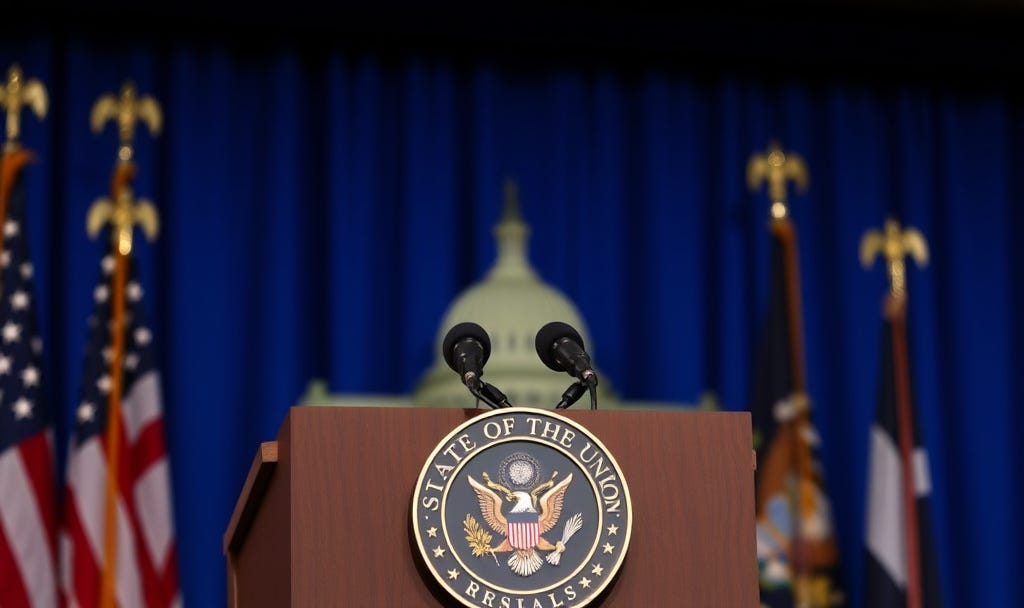
I envision this moment arriving during a State of the Union Address—made in both the state of an appeal and a dictate. The appeal is to the people, the dictate to the people in the chamber. The appeal to a collective will. The dictate made against those preventing the will from being achieved.
During the address, there has to be a blend of righteous indignation and calm and clever cunning, of appeals to the past, portrayals of a future—of what can be and how it must be achieved. Overall, what is depicted is a takeover, one that has occurred quickly—in fact has already been executed behind the scenes, ironically enough.
The portrait, then, is a formalization of a process completed behind the scenes, the announcement to the nation that power has been consolidated, actively seized by the executive of the executive branch.
“The State of the Union is not strong… and here is why”: A gesture to the in-House audience, a mention of others responsible for decline.
“Empowering a return to ascent requires the empowering of one man.” You’re with him or you’re not. If you’re not, the descent continues.
What an image—the continuation, assumption even, of American Supremacy.
The counters will come: “Stop dreaming… this is an impossibility.”
But the man of authority does not care what seems impossible right now. What’s needed and what’s required–no matter how difficult the path is that lay ahead–must first be envisioned, then acted upon.
“Imagination runs the world.” ~Napoleon